The Authorized User Loophole: How to Get 6 People into Lounges for $0
If you’ve tried to access airport lounges recently with your family, you’ve probably noticed something: it’s not as easy—or as cheap—as it used to be.
Over the past year, issuers like Capital One and American Express have made quiet but meaningful changes to their lounge access policies. Guest access, which used to feel generous and flexible, is now far more restricted. In many cases, you’re either paying per person or being pushed toward adding authorized users at a significant cost.
The New Reality of Lounge Access
For families, this creates a real problem. What used to be a simple “scan one card and walk in together” experience has turned into a math equation, and not a favorable one.
If you’re still figuring out which cards even offer lounge access for families, start here:
→ Best Credit Cards for Airport Lounge Access for Families (2026 Guide)
But there’s a specific strategy that still works extremely well in this new environment. I call it the Authorized User Loophole, and when you structure it correctly, it allows a family of six (or more) to access lounges without paying any additional guest fees.
The Strategy Most People Are Missing
Most people approach lounge access with the assumption that one premium credit card should cover the entire family. That used to be a reasonable expectation, but it’s no longer how these benefits are designed to work.
The shift that’s happening right now is subtle but important: instead of relying on a single membership with guest privileges, you need to think in terms of multiple memberships within the same household.
In other words, instead of bringing guests, you’re creating more cardholders.
This is a shift I break down in detail in my full guide to lounge access strategies for families:
→ Best Credit Cards for Airport Lounge Access for Families (2026 Guide)
This is where authorized users come in. Not as a way to help hit a minimum spend, but as a way to duplicate access.
Why Authorized Users Matter More Than Ever
When a credit card allows you to add authorized users for free and provides each user with their own lounge membership, you’re no longer limited by a single set of guest rules. You’re effectively multiplying your access.
For example, a typical lounge membership like Priority Pass might allow a cardholder to bring in two guests. On its own, that’s helpful, but limited for a larger family.
However, if both you and your spouse each have your own membership, that same “two guest” rule now applies twice. Instead of trying to fit your entire family under one account, you’re splitting the entry across two.
That’s the entire concept behind this strategy, and once you understand it, the math starts to work in your favor again.
Want the exact setup I use for my family (without overthinking it)?
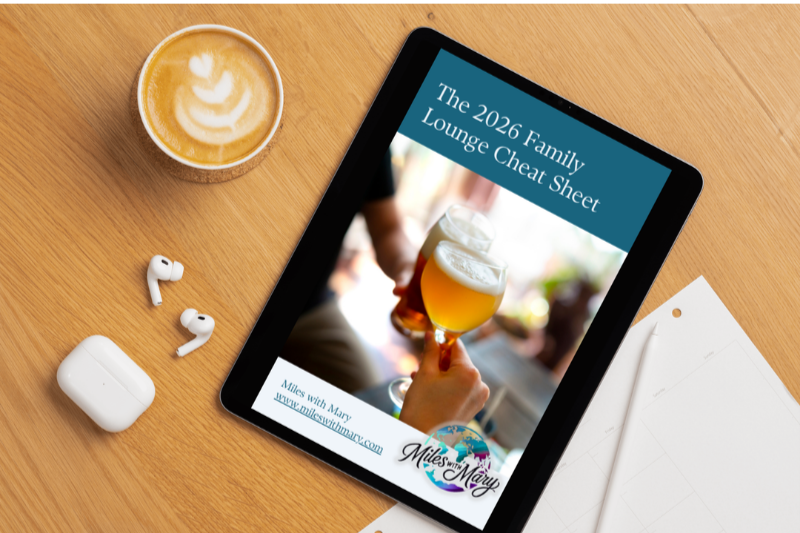
I put together a simple Lounge Access Cheat Sheet for Families that shows:
Which cards actually work for families
How to structure authorized users
How to avoid guest fees entirely
Get the Lounge Access Cheat Sheet for Families
Step-by-Step: How This Works for a Family of 6
Let’s walk through an example using the Ritz-Carlton card (which you can access via product change).
If you don’t already have this card, you can’t apply for it directly, but you can get it through a product change. I walk through exactly how to do that here:
→ How to Get the Chase Ritz-Carlton Card (Step-by-Step)
First, you add your spouse as an authorized user. On this card, there is no fee to do this, which is what makes the strategy viable in the first place.
Once your spouse is added, both of you will receive separate lounge memberships. These are not shared accounts, you each get your own login, your own card, and your own set of guest privileges.
From there, the execution is simple but powerful.
When you arrive at a lounge, you don’t enter as a group under one person. Instead, you split your entry. You scan your membership and bring in two of your children, while your spouse scans theirs and brings in the other two.
The result is that all six of you enter the lounge without triggering any additional guest fees.
This is one of the highest-leverage moves you can make for family travel right now, especially if lounge access matters to you. If you want to set this up, start here:
→ How to Get the Chase Ritz-Carlton Card
Why This Matters (The Real Math)
What makes this strategy so effective isn’t just that it works, it’s how much it saves over time.
If you were to rely on a single membership and pay guest fees for additional children, you could easily be looking at $30–$35 per person, per visit. That might not sound like much at first, but it adds up quickly across multiple flights.
A single trip with multiple lounge visits could cost well over $100 in guest fees alone. Multiply that across a year of travel, and you’re suddenly paying hundreds of dollars for something that could have been structured differently from the start.
With the authorized user setup, those costs disappear entirely. You’re not just saving money—you’re changing the framework of how you access lounges as a family.
👉 I made a Lounge Access Cheat Sheet for Families so you can see exactly which cards to use and how to structure this without guessing.
Grab it here → Lounge Access Cheat Sheet for Families
The Venture X Problem (Why This Strategy Matters Now)
To really understand why this approach is so valuable, it helps to look at what’s changed across other popular cards.
Take the Capital One Venture X, for example. For a long time, it was one of the easiest recommendations for families because authorized users were free and lounge access was generous.
That’s no longer the case.
I break down exactly what changed, and whether it’s still worth holding, in this full review:
→ Is the Venture X Still Worth It in 2026? (The Brutal Truth for Families)
As of 2026, adding authorized users comes with a cost, and guest access is far more limited than it used to be. For a family of four or six, that means you’re either paying to add additional users or paying per visit when you enter the lounge.
Either way, the “easy win” that this card used to provide for families has been significantly reduced.
If you currently have the Venture X, this is one of those moments where you need to decide whether to keep it, downgrade it, or replace it entirely. I walk through that decision step-by-step here:
→ Is the Venture X Still Worth It in 2026?
And this is exactly why the authorized user strategy matters now more than ever. It’s not just about maximizing a benefit, it’s about adapting to a system that no longer favors larger groups.
The Amex Variation: Morgan Stanley Platinum
If you’re more invested in the American Express ecosystem, there is a version of this strategy that can work out really great.
The American Express Platinum Card issued through Morgan Stanley allows you to add your first authorized user at no cost. Like the Chase setup, each person receives their own Priority Pass membership, which means you can apply the same “split entry” approach for those lounges.
Where things differ is with the Centurion Lounge network.
Unlike Priority Pass lounges, Centurion Lounges typically charge for guests unless you meet specific spending thresholds. That means even if both you and your spouse have access, bringing children into those lounges may still come with an additional fee.
So while this variation can still be useful, especially if you frequent Priority Pass locations, it doesn’t offer the same level of flexibility as the Chase-based setup. But honestly, you can use this authorized user loophole for many cards. Even authorized user cards that come at a cost can make sense if you value the credits and benefits of that specific card.
The “Unlimited Guest” Myth
If you’ve been in this space for a while, you might remember hearing that certain cards, especially the Ritz-Carlton, offered unlimited guest access.
That information is now outdated.
As of January 15, 2026, Chase standardized lounge access across its premium cards. Instead of allowing unlimited guests, memberships are now capped at two guests per cardholder.
At first glance, that sounds like a devaluation, and in many ways, it is. But it also reinforces why this strategy works so well.
You’re no longer relying on one membership to do all the work. You’re intentionally spreading access across multiple memberships within your household, which restores the flexibility that was lost with the rule change.
Is This Actually a “Loophole”?
The word “loophole” makes this sound like you’re getting away with something you’re not supposed to do. You’re not. This is simply a matter of understanding how benefits are structured and using them as intended.
Banks offer authorized user cards for a reason. They want multiple people in a household using their product, building familiarity, and ultimately staying within their ecosystem. When those authorized users receive their own lounge memberships, that benefit is being extended exactly as designed.
All you’re doing is organizing your access in a way that minimizes unnecessary fees.
Who This Strategy Makes the Most Sense For
This approach is especially valuable if you travel as a family and regularly pass through airports where lounge access makes a difference.
If you have more than two people in your group, and especially if you have young children, the cost of guest access can add up quickly. In those situations, structuring your cards correctly ahead of time can make a meaningful difference in both cost and convenience.
On the other hand, if you typically travel solo or as a couple, this level of optimization may not be necessary. In those cases, a single premium card with standard guest access may be more than sufficient.
The Bigger Lesson (This Is What Actually Matters)
It’s easy to look at this as just another trick or tactic, but there’s a broader takeaway here.
The rules around points, miles, and travel benefits are constantly evolving. What worked a few years ago, or even last year, doesn’t always hold up today.
The people who consistently get outsized value are the ones who adjust their strategy as those changes happen. They’re not just collecting cards, they’re thinking about how those cards work together.
This is a perfect example of that shift.
Instead of relying on one card to solve the problem, you’re building a small system within your household that restores flexibility and eliminates unnecessary costs.
Want This Set Up Done for You?
Lounge access used to be simple. Now it’s a system.
If you want to skip the trial and error, I created a Lounge Access Cheat Sheet for Families that breaks this down into a simple, actionable setup.
Inside, I show:
The exact cards I’d use for a family of 4–6
How to structure authorized users correctly
Which lounges actually allow this strategy
👉 Download it here → Lounge Access Cheat Sheet for Families
Next Steps
If you want to go deeper on building a complete lounge access strategy, these are the best places to start:
And if you’re still learning how all of this fits together:
👉 Start with my Beginner’s Guide to Points & Miles for Families
MileswithMary.com/beginners-guide
Final Thought
Lounge access didn’t disappear, it just got more structured.
Once you understand that shift, you can stop chasing “the best card” and start building a setup that actually works for your family.
Read More: