How to Book Cheap Cruises for Your Family
Family cruises normally cost thousands of dollars.
For a family of four, it’s not unusual to see price tags between $4,000 and $8,000 once you factor in cabins, gratuities, drinks, excursions, and travel to the port.
But in the past two years, my family has taken six different cruises. And for most of them, we paid very little out of pocket.
Some were fully comped. Others were stacked with discounts, credits, casino offers, and credit card points.
Once we realized how perfect cruising is for traveling with young kids (you only unpack once, food included, easy logistics), it became my mission to figure out how to keep these cheap cruises going long term.
Here are some strategies for saving money on cruises.
Disclaimer: This page contains affiliate links. If you choose to make a purchase after clicking a link, I may receive a commission at no additional cost to you. Thank you for your support!
1. MyVegas Cruise Offers
One of the easiest entry points into discounted cruises is through the MyVegas apps.
These are free casino-style mobile games where you earn loyalty points as you play. Those points can be redeemed for real travel rewards.
Most people know about the Las Vegas hotel rewards, but you can also redeem cruise offers. The cruise partners change over time. At the time of writing, the primary partner is Norwegian Cruise Line, but in the past I’ve also seen Royal Caribbean International and MSC Cruises.
There are usually two types of rewards:
Comped cruise offers
These cover the base fare for two passengers. However, with the NCL cruise offers, you’ll still pay daily admin fees (around $20 per person per day) plus taxes and port fees. So it’s not completely free, but it can still be a substantial discount.
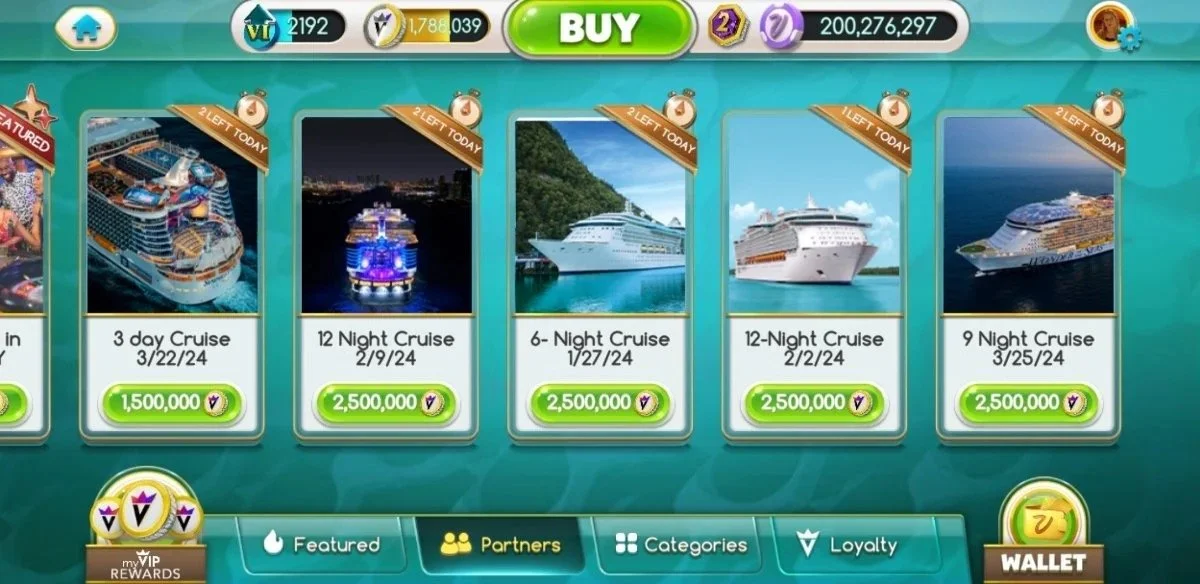
Comped casino cruises through myvegas
Dollar-off cruise offers
These might offer $500–$1,000 off your cruise fare. I personally prefer these because you avoid daily admin fees (NCL specific), and can stack them with public promotions or cruise certificates.
If you’re traveling with kids, consider having both parents earn rewards separately so that you can potentially book two cabins and request connecting rooms.
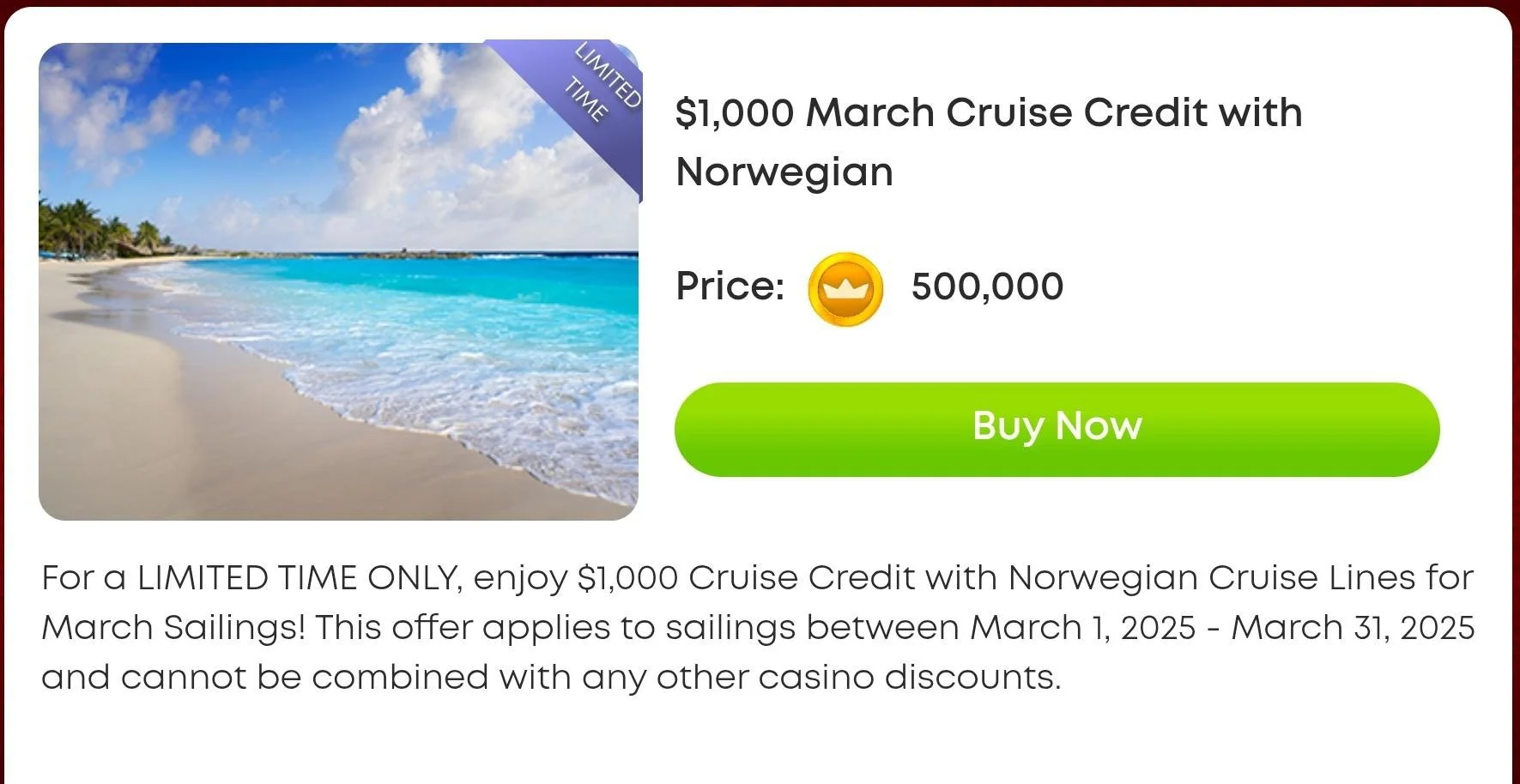
Example of dollar-off cruise offers
If you’re not sure how the MyVegas apps work, then watch my youtube video where I break them down and show you how valuable they can be.
2. Casino Offers & Status Matching
This is the strategy that gave our family six highly discounted cruises.
And no, you don’t necessarily have to be a gambler.
Most major cruise lines operate casino programs. If you have a casino player’s card or elite casino status, you may qualify for cruise offers.
In our case, I had hotel status through a credit card. That matched to Caesars Rewards Diamond status, and that status triggered cruise offers.
From there, we matched offers across cruise lines including:
MSC Cruises
Holland America
Princess Cruises
Virgin Voyages
Carnival Cruise Line
One match turned into multiple sailings.
Even now, we lightly gamble onboard (strategically, focusing on lower house-edge games like video blackjack or video poker) to generate future offers.
Read more: How One $95 Credit Card Turned Into Six Nearly Free Cruises
For example, we booked a 12-night European sailing in a balcony cabin for about $3,200 total for four people, including free drinks everywhere on the ship for two adults.
That’s stacking in action.
If you want the full step-by-step breakdown of how we did this, I walk through the entire process in detail in my YouTube video on casino matching.
Caesar’s Diamond status also gives you access to an annual comped trip to Atlantis. We have taken this trip twice so far.
Read more: Atlantis Bahamas Review with Caesar’s Diamond: What It Really Cost Our Family
3. Buy Discounted Cruise Gift Cards
Even if you don’t want to touch casino offers, you can still lower cruise costs.
Websites like Raise/GCX often sell cruise gift cards below face value. Even a 5–8% discount can save hundreds on a $4,000 cruise.
Get $5 when you sign up for Raise/GCX through my referral link
Now layer in credit card rewards.
You can often buy cruise gift cards at grocery stores like Publix or Kroger. Using a card like the American Express Gold Card earns 4x points at grocery stores.
Now you’re:
Saving on the cruise
Earning points
Potentially earning fuel rewards
That’s stacking.
You can also use monthly credits from cards like the American Express Business Gold Card to purchase gift cards at office supply stores, which can then be used toward cruise expenses such as Disney Cruise Line sailings.
This is exactly how I evaluate annual fees. I only count credits that I would use anyway.
Check out the best travel credit cards on the market and find out which one is best for you

4. Cashing Out Points for Cruise Purchases
Cruises are not typically a high-value transfer partner redemption.
But you can still use points.
One of the simplest approaches is to book the cruise with a card that earns bonus points on travel purchases, such as the Chase Ink Business Preferred, which earns 3x points on travel.
Let’s say your cruise costs $3,000.
You put that charge on your card and earn 9,000 Ultimate Rewards points from the purchase. Then, you go into your Chase account and redeem points toward that travel purchase at approximately 1 cent per point.
If you wanted to fully offset a $3,000 cruise at 1 cent per point, you would need 300,000 Ultimate Rewards points.
Is that the highest possible value for your points? No.
In many cases, transferring 300,000 points to airline partners could get you multiple international business class seats. From a pure cents-per-point perspective, 1 cent per point is low.
But here is where context matters.
If your goal is reducing cash out of pocket, this strategy can still make sense. Cruises are often large lump-sum expenses. Even partially offsetting the cost can free up thousands of dollars that would otherwise leave your bank account.
It can also make sense if:
You have a large points balance and limited travel flexibility
You are not finding strong transfer partner redemptions
You value simplicity over maximizing every last cent
Personally, I prefer transferring points for flights and hotels when possible. That is usually where the highest value lives. But when I am looking at a cruise that cannot easily be transferred to a partner, and I want to lower the out-of-pocket cost, redeeming at 1 cent per point becomes a practical tool.
It is not glamorous, but it is effective.
And sometimes reducing a $3,000 cruise to $1,000 out of pocket is the win.
Read more: Why Cruises Are The Ultimate Family Vacation (Especially with Young Kids!)
5. The Aeroplan Pay-Yourself-Back Strategy
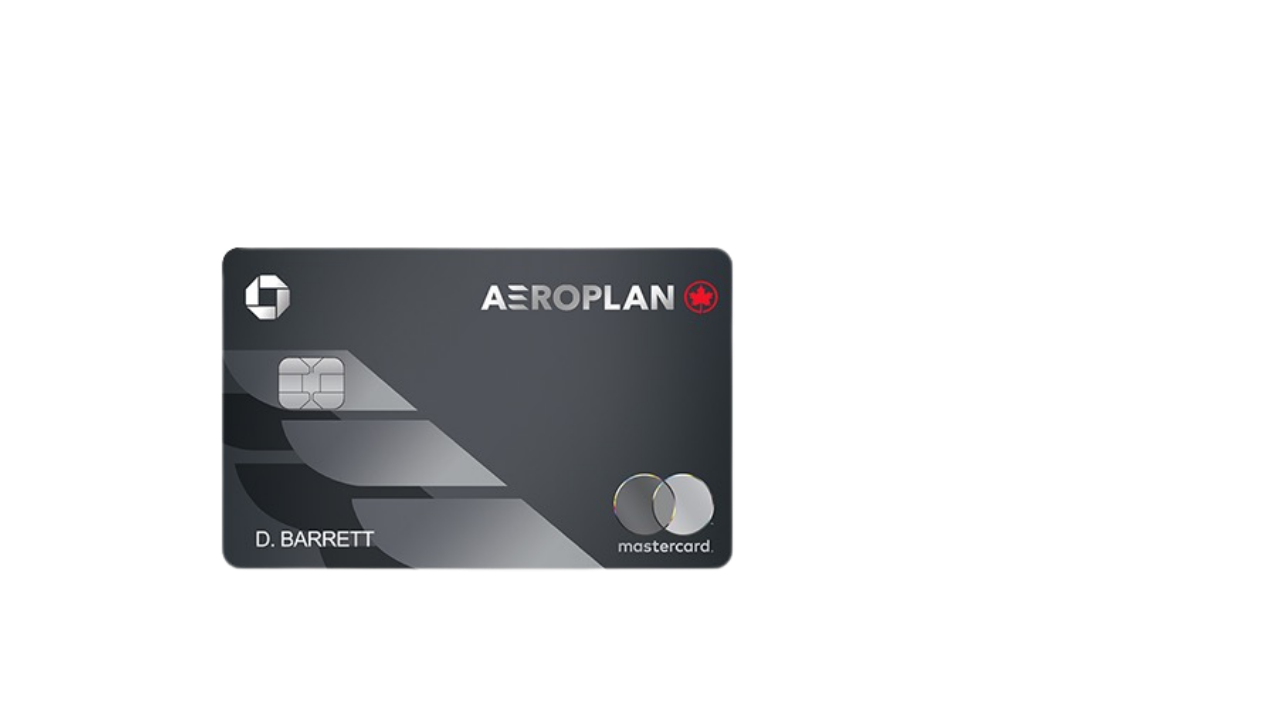
The Chase Aeroplan Card has one feature that makes it especially interesting for cruise purchases.
Unlike most Chase cards that redeem points toward travel at 1 cent per point, this card allows you to use the Pay Yourself Back feature at 1.25 cents per point for eligible travel purchases, up to $2,000 per account anniversary year.
Here’s what that looks like in real numbers.
Let’s say your cruise costs $2,000. You put the entire charge on your Aeroplan card. You then go into your Chase account and redeem points to erase that purchase at 1.25 cents per point. Instead of needing 200,000 points (at 1 cent per point), you would need 160,000 points to wipe out that $2,000 charge.
That alone is already better than standard cash redemptions.
But it can get even stronger.
If you transfer Ultimate Rewards points to Aeroplan in chunks of 50,000 points or more, the card offers a 10% points rebate, up to 25,000 bonus Aeroplan points per year. That means if you transfer 50,000 points, you effectively get 55,000 Aeroplan points.
Now layer in something Chase offers fairly regularly: a 20% transfer bonus to Aeroplan.
Here’s where the math gets interesting.
If you start with 100,000 Ultimate Rewards points and there is a 20% transfer bonus, you receive 120,000 Aeroplan points. If that transfer qualifies for the 10% Aeroplan rebate, you could end up with an additional 12,000 points back, effectively bringing your usable total to 132,000 Aeroplan points.
When those points are redeemed at 1.25 cents per point through Pay Yourself Back, you are effectively getting around 1.6 cents per Ultimate Rewards point in value.
That is significantly better than a standard 1 cent cash redemption, and it can make a big difference when offsetting cruise expenses that do not have strong transfer partner sweet spots.
I’ve personally used this strategy to erase travel purchases that I could not otherwise redeem through airline or hotel partners. It’s not always the highest possible value, but it’s a powerful option when your goal is reducing out-of-pocket costs on something like a cruise.
Are you new to points and miles?
Pick up a copy of my free beginner’s guide to points and miles and learn how to get started earning points to fund your travel.

Read more: 5 Amazing Trips You Can Book with Points (Instead of Cash)
6. Booking a Cruise Entirely With Points
There is currently one cruise line where you can truly book the cruise itself using points instead of cash: Virgin Voyages through the Virgin Red loyalty program.
Virgin Voyages is an adults-only cruise line, so this option does not apply to family sailings. But it is still worth understanding because it is one of the only ways to cover nearly the entire cruise fare with transferable credit card points.
When you search Virgin Voyages sailings through Virgin Red, you will see pricing displayed entirely in points. Most balcony cabins for two people fall somewhere between 175,000 and 300,000 points and up depending on the length of the cruise, cabin category, and sailing date.
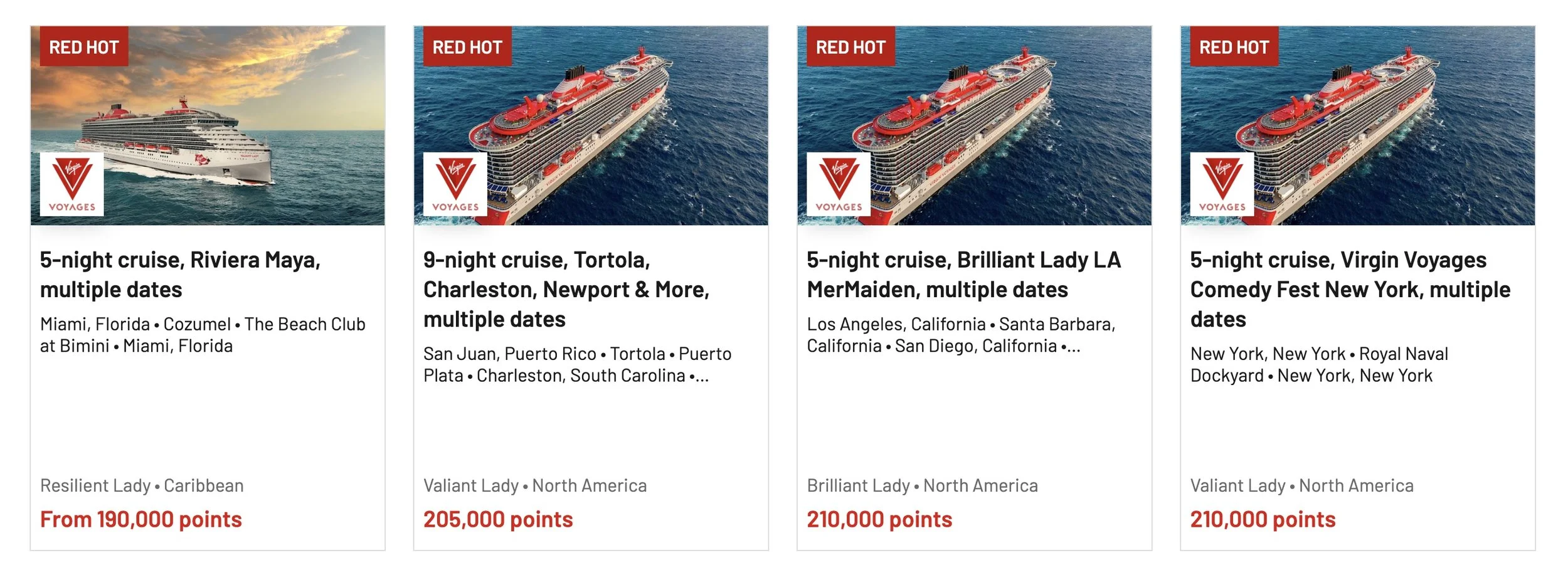
Virgin Voyages Cruises Bookable with Points
What makes this redemption interesting is that the points price includes the cruise fare, taxes, and fees. You are not paying a separate base fare and then adding mandatory fees on top. However, gratuities are no longer included, so you should still budget for those.
Let’s talk about value.
At the lower end, around 175,000 to 200,000 points for a balcony cabin, this can be a reasonable redemption, especially if you catch a transfer bonus from a program like Chase or American Express to Virgin Atlantic or Virgin Red. Transfer bonuses of 20% to 40% are not uncommon.
For example, if there is a 30% transfer bonus, a cruise priced at 200,000 points would effectively require closer to 154,000 transferable credit card points. That can materially improve the value proposition.
But once you move toward the higher end of the range, around 275,000 to 300,000 points, you need to pause and compare opportunity cost.
300,000 transferable points could potentially cover:
Multiple international business class flights
Several long-haul premium cabin seats
Multiple Hyatt stays at luxury properties
From a pure value perspective, those redemptions may generate more cents per point than using them for a cruise.
That does not mean a Virgin Voyages redemption is “bad.” It simply means it is situational.
It can make sense if:
You prefer an adults-only cruise experience
You are sitting on a large points balance
You catch a strong transfer bonus
You value simplicity and want zero base fare out of pocket
Personally, I look at this as a strategic option rather than a default move. For our family cruises, casino offers and stacking strategies tend to produce stronger overall value. But for an adults-only getaway, especially during a transfer bonus window, booking a Virgin Voyages sailing entirely with points can be a compelling way to travel without writing a large check.
As with everything in points and miles, the right answer depends on what you are giving up in exchange.
Read More: What Are Your Points Really Worth? Understanding Cents Per Point
7. Stack Excursions & Onboard Spending
Cruise fares are only part of the total cost.
Excursions, specialty dining, drink packages, spa treatments, and transportation to and from the port can easily add hundreds or even thousands of dollars to the overall trip.
This is another area where stacking strategy matters.
Booking Shore Excursions Strategically
Most cruise lines heavily promote their own shore excursions. They are convenient, but they are not always the best value.
Before booking directly through the cruise line, I always compare pricing on third-party platforms like Viator.
View cruise excursions here on Viator.
Often you will find:
Lower prices
Smaller group sizes
More unique local experiences
Flexible cancellation policies
For example, a cruise line might charge $159 per person for a snorkeling excursion, while a similar experience on Viator could be $99 per person. Multiply that by four people and that difference becomes meaningful.
Layering Rewards on Excursions
Now stack it.
Book excursions using:
A card that earns bonus points on travel purchases
A card that earns bonus points on dining if the excursion codes that way
A card with travel protections
For example, using a card like the Chase Sapphire Reserve earns elevated rewards on travel purchases and includes travel protections.
Read More: Chase Sapphire Reserve Credit Card Review
You can also route bookings through cashback portals like Rakuten when available.
Sign up for Rakuten here and earn a welcome bonus of at least $30 or more
Even an additional 1–3 percent back compounds when layered with category bonuses.
Again, no single move is dramatic.
But layering:
Lower excursion pricing
Bonus category earnings
Cashback portal rewards
Travel statement credits
can meaningfully reduce the total cost of your cruise.
Pre-Cruise and Post-Cruise Spending
Do not forget the edges of the cruise.
You may need:
A hotel near the port
Airport transfers
Flights
Travel insurance
For pre-cruise hotels, compare rates through platforms like Booking.com or Expedia.
Compare Hotels Near the Cruise Port
For airport transfers or private tours, compare options on Viator.
For travel insurance coverage, especially for cruises and international sailings, compare policies before departure.
Compensair – A service that helps customers receive compensation for flight delays, cancellations, or denied boarding.
EKTA – A new generation insurance company that combines competitive prices with a high level of service.
World Nomads – I personally used World Nomads and it saved me almost $2000 when a trip went sideways!
Each of these pieces may feel small individually.
But stacking:
Discounted excursions
Cashback portals
Credit card bonus earnings
Travel insurance protections
is how you lower the real cost of cruising beyond just the base fare.
If You’re Just Getting Started
If you want to build the kind of points balance that makes these strategies possible, grab my free Beginner’s Guide to Points & Miles.
And if you want to see exactly how we turned one casino match into six discounted cruises, watch my full breakdown on YouTube where I show the process step by step.
Cruising doesn’t have to cost a fortune.
You just need to think in layers.
Read more:
Trip Review - Cruise on Carnival Sunshine
More posts on the blog below:







New on the Blog
Credit Card Reviews